Research question
When does waiting for a compatible camera frame improve timely output, and when does waiting cause more primary frames to be dropped?
Method
Six policies were compared across eight synthetic workloads with 40 independent seeds per workload. The evaluation required both a timestamp difference of at most 10 ms and a primary frame age of at most 60 ms. Historical iPhone observations describe capture continuity in a separate screen-recording workflow.
Key findings
- Compared policies
- 6
- Synthetic workloads
- 8
- Seeds per workload
- 40
- Under simulated callback jitter, accepting the first compatible pair yielded 91.59% qualifying outputs, compared with 51.30% for immediate latest-frame matching.
- Under simulated sustained overload, the first-compatible strategy yielded 47.90% qualifying outputs, compared with 3.12% when always waiting for the full budget.
Limitations
Scheduler comparisons use synthetic traces. Historical phone records cover capture continuity and lack paired camera timestamps for measuring frame skew.
Full manuscript
Web reading edition of the submitted manuscript, including text, original figures, tables and references.
Abstract
Dual camera compositors must select temporally compatible frames while avoiding unbounded delay when capture callbacks or rendering become irregular. This study examines the interaction between timestamp matching and admission control through a reproducible discrete event model. Six policies are compared on eight synthetic workload families, using 40 independent seeds per family and shared traces across policies. The model separates presentation timestamps, callback arrival times, waiting time and compositor service time. A first admissible match policy combines a timestamp tolerance with a finite waiting budget and a single outstanding composition. At a 10 ms tolerance and 20 ms waiting budget, it produces jointly admissible outputs for 91.59% of primary frames under the specified jitter workload, compared with 51.30% for immediate latest frame selection and 70.23% for full budget waiting. Under sustained overload, full budget waiting reduces this proportion to 3.12%, whereas first admissible matching achieves 47.90%. A phase offset workload produces no admissible pairs at the same tolerance, demonstrating that buffering cannot replace capture synchronization. Historical iPhone 16 Pro records for an adjacent screen recording workflow document camera interruption in a standard build and continued capture in a diagnostic build. These observations motivate treating source availability separately from pairing. The policy comparisons and timing metrics come from simulation. The contribution is a controlled account of when waiting helps, when admission control dominates, and which timing guarantees follow from the policy rather than the workload.
Keywords
dual camera video; timestamp matching; bounded buffering; admission control; discrete event simulation; real time compositing
1 Introduction
A picture in picture recording can remain visually continuous even when its two views depict different moments. A compositor that selects the most recently delivered secondary frame has no direct guarantee about that frame’s presentation timestamp. Conversely, a compositor that waits for a closer match may miss primary frames because waiting occupies a finite processing resource. The engineering problem is therefore not captured by frame rate, average latency or timestamp error considered separately.
The motivating implementation is a mobile dual camera recorder whose inspected callback path retains the latest buffer for each camera and submits primary frames only while no composite is in flight. That code provides a concrete source of the question, not the experimental dataset. No timing trace from that application is used here. All experiments use generated timestamps and prescribed service durations, enabling separate manipulation of callback delay, loss, rate mismatch and compute load.
This paper studies reusable secondary frames in a primary driven compositor. It does not estimate unknown camera clocks or reconstruct temporally aligned images. The central question is whether a bounded wait should end at the first acceptable pair or at the end of the allotted budget, and how that choice interacts with a busy compositor. Three subquestions guide the analysis: how many primary frames produce a pair within both skew and age thresholds; what happens when compute service exceeds the primary period; and when no amount of waiting can create an admissible pair.
The contribution is an explicit, executable comparison of policies and their failure conditions. Timestamp thresholds, finite queues and dropping under overload are established techniques; none is claimed as a new synchronization primitive. The comparison is deliberately small enough to reproduce and inspect. It yields workload conditional evidence and implementation requirements rather than a universal ranking or a claim of hardware performance.
2 Related work and scope
Capture synchronization and application buffering solve different problems. Ansari et al. [1] synchronize clocks and capture phase across smartphone cameras. Albl et al. [2] jointly estimate temporal displacement and two view geometry. Such techniques address temporal alignment before or through image analysis. The present model assumes timestamps are already expressed in a common clock and examines selection among samples that have reached the application. It cannot recover a missing simultaneous exposure.
Apple’s AVCaptureDataOutputSynchronizer coordinates time matched output delivery [3]. Its documented behavior uses a main output and waits until the other outputs have progressed sufficiently or the corresponding data is known to be absent [4]. This establishes a necessary platform comparison for future deployment. The simulator does not reproduce Apple’s internal scheduling or measure that API, and its policies must not be read as evidence of superiority over native synchronization.
ROS message_filters provides exact and approximate timestamp synchronization [5]. Approximate matching with a finite queue is thus a relevant existing mechanism. The policies below allow a secondary image to be reused, as can be appropriate for picture in picture compositing; a synchronizer that consumes messages on each match has different semantics. We therefore use descriptive policy baselines rather than labeling an independently implemented baseline as ROS. A faithful ROS integration benchmark remains outside the present evidence.
Frame dropping is also an established latency control technique. Apple’s frame drop guidance discusses limited buffering and reducing frame rate when processing is persistently slow [6]. Our single outstanding composition rule isolates one such admission decision. Age of information research distinguishes freshness from simple transmission throughput [7]. We adopt capture to completion age as a per output metric, not the full time average age of a receiver’s displayed state. This distinction matters because rejected frames are not observations with zero error.
3 Model and admissibility criteria
3.1 Events and clocks
Primary frame i has presentation time tᵢ, callback arrival aᵢ and compositor service duration cᵢ. Secondary frame j has presentation time uⱼ and arrival bⱼ. All times are in milliseconds on one clock; arrivals cannot precede their own presentation times. Callback delivery is ordered within each stream, with equal or inverted arrivals adjusted to the previous arrival plus one nanosecond. Primary timestamps increase strictly. Secondary frame reuse is permitted, and no image interpolation is performed.
A policy starts composition at sᵢ using an arrived secondary frame j and completes at fᵢ = sᵢ + cᵢ. Its skew is the absolute difference between tᵢ and uⱼ. Its wait is sᵢ − aᵢ, and its primary age at completion is fᵢ − tᵢ. These quantities exclude sensor exposure timing uncertainty, display scanout, encoding, audio processing and file persistence. They are simulated scheduling quantities, not measured end to end video latency.
3.2 Jointly admissible output
An output is jointly admissible when its skew is at most ε and its primary age at completion is at most A. The reported proportion divides the number of such outputs by all generated primary frames, including busy drops and unmatched frames. The central settings are ε = 10 ms and A = 60 ms. These are engineering evaluation thresholds selected for this model, not established perceptual thresholds. Results must be interpreted together with output proportion, skew and age, not as a single perceptual quality score.
For an admitted pair within ε, secondary age differs from primary age by at most ε. Bounding primary age alone therefore does not guarantee that both views meet the same age deadline. Likewise, low timestamp skew is not proof of optical simultaneity if timestamps are biased. Clock calibration and exposure verification are separate requirements for an implementation.
3.3 Resource model
The secondary buffer retains at most K frames, evicting the oldest callback when full. Unless stated otherwise K = 8. Five policies permit only one primary request to be pending or processing; a newly arriving primary is discarded while that slot is occupied. Waiting for a secondary frame reserves the slot. Service is nonpreemptive and its duration is attached to the generated primary frame, so policy comparisons use the same potential service cost for that frame. FIFO is the deliberately unbounded primary queue baseline.
A secondary image chosen for composition is conceptually retained until service finishes. Therefore an implementation needs capacity for the K cached secondary buffers and an additional selected reference when eviction occurs, plus the current primary and output allocation. The simulated buffer count is not total memory usage. Frame dimensions and pixel formats are absent, so no memory consumption in bytes is claimed.
4 Compared policies and guarantees
Latest selects the latest arrived secondary frame immediately on an admitted primary callback. Nearest now selects the arrived frame with minimum timestamp distance. Gate now adds the ε criterion to nearest now and immediately rejects a primary for which no acceptable frame is available. All three share the single outstanding composition rule; a missing secondary frame results in no output.
Wait first checks the buffer immediately. If an admissible frame exists, it selects the nearest such frame and starts service. Otherwise, it advances to successive secondary arrival events, selecting the nearest admissible frame at the first event that makes one available. If none is available by aᵢ + B, the primary is rejected and its slot released. Ties prefer the smaller secondary timestamp. This is a feasibility policy: it does not wait for a potentially even closer future frame once the tolerance is met.
Wait full retains the primary until aᵢ + B, then selects the nearest retained secondary frame and applies the same tolerance. It may find a closer timestamp, but always consumes the full wait budget. FIFO latest queues every primary and selects the latest available secondary when service can begin. The latter differs in admission control as well as matching time; it is included to reveal backlog rather than serve as a tightly isolated matching ablation. Nearest now versus gate now, and wait first versus wait full, provide the narrower contrasts.
4.1 Local guarantees
For the three gated policies, every emitted pair has skew at most ε because the predicate is checked immediately before composition. This is a conditional guarantee about emitted pairs; a policy that emits nothing satisfies it vacuously. The denominator in the joint output measure prevents this vacuity from being mistaken for useful performance.
For wait first and wait full, waiting time is at most B by construction. If capture to callback delay is bounded by L and service by C, primary age at completion is at most L + B + C. Without bounds on both callback delay and service, the wait budget alone gives no hard age bound. The Gaussian workload generator below has no finite distributional upper bound on service, so the measured age percentiles are not hard real time guarantees.
With bounded secondary capacity K and one pending primary, selection requires at most K timestamp comparisons per examined event. Maintaining the cache needs constant time per arrival with a deque; a direct nearest search costs O(K). The proof concerns the algorithmic model. It does not bound scheduler overhead, memory allocation, graphics command execution or operating system interference.
4.2 Impossibility and tradeoff cases
If every secondary timestamp is farther than ε from a primary timestamp, no selection policy can emit an admissible pair for that primary. Increasing B or K cannot change that fact. For equal frame periods P and a fixed phase offset δ, the smallest possible timestamp gap is the smaller of δ and P − δ. When that gap exceeds ε, phase correction or a relaxed specification is required.
Nor does bounded waiting imply higher throughput. When waiting and rendering share one slot, accepting a frame after a long wait can block the next primary. Under deterministic service longer than P, a single slot necessarily rejects arrivals; an unbounded FIFO can accept them but accumulates delay. A waiting policy must therefore be evaluated at the intended utilization, not only under idle rendering.
5 Experimental method
The reference implementation is a standard library Python discrete event simulator supplied as Online Resource 1. It processes ordered callbacks without sleeping, acquiring a camera or rendering pixels. The main comparison contains eight scenario families, 40 seeds each, six policies and 1,800 primary frames per trace: 320 generated trace pairs and 1,920 policy runs. Every trace represents 60 seconds with a 30 frame per second primary stream. The same trace and service samples are replayed across policies. Seed is the unit of replication.
The primary callback delay is max(0, Normal(3, J)). Secondary delay is max(0, Normal(3 + D, J)). Service is max(0.1, Normal(C, 0.12C)). Normal distributions are parameterized by mean and standard deviation; the max operation clips their lower tail. Values are milliseconds. Central parameters are J = 2, D = 2 and C = 8. Presentation times are ideal periodic sample times rather than inferred from callback arrival. Random loss affects secondary frames only. The outage removes secondary samples whose timestamps lie in [20000, 21000). Startup is included and no warmup period is discarded.
The asymmetric scenario sets D = 18, jitter sets J = 12, loss independently removes 10% of secondary samples, and overload sets C = 45. Mixed rate uses a 24 frame per second secondary stream. Phase offset shifts secondary presentation times by 16 ms at 30 frames per second. Each scenario changes the stated parameter relative to the central setting; the outage and loss are not camera measurements. They test mechanisms, not an estimated population of real recordings.
A waiting budget sweep uses B = 0, 5, 10, 20, 30 and 40 ms on asymmetric, jitter, mixed rate and overload traces, for both waiting policies and all 40 seeds. A separate capacity and tolerance sweep crosses K = 1, 2, 4, 8 and 16 with ε = 5, 10, 16, 20 and 34 ms on nominal, jitter and phase offset traces. These are sensitivity analyses rather than tuning on a held out dataset. Their raw results are included, including unfavorable settings.
Each run reports output proportion, jointly admissible proportion, 95th percentile skew, 95th percentile primary age, busy drops, unmatched rejections, repeated secondary identifiers, and cache occupancy. Percentiles are linearly interpolated within each run and then averaged across seeds. A missing percentile is reported as not applicable when a policy produces no output; it is not converted to zero. Mean contrasts use matched seeds, with descriptive 95% t intervals using 39 degrees of freedom. These intervals quantify generator variability only, not uncertainty about real devices or perceptual thresholds.
Deterministic checks cover late but admissible arrival, absent secondary data, stale frame rejection, an inclusive tolerance boundary and seed reproducibility. Runtime assertions check accounting of every primary, the tolerance predicate for every gated output, the wait budget and bounded cache occupancy. This verifies internal invariants, not equivalence with AVFoundation or ROS. The code, configuration, run metrics and script hash are retained so results can be regenerated independently.
OpenAI Codex assisted with research framing, simulator construction, execution, analysis and manuscript drafting. This assistance goes beyond copy editing. The experiments execute code and report its generated outputs; no model generated number is substituted for an experimental result. Author review of the implementation, interpretation and final manuscript is required before submission. No human participants or personal datasets are included.
6 Results
6.1 Timestamp gating and short waiting
Under the nominal generator, latest and nearest now emit 99.96% of primary frames but only 23.88% meet both criteria. Wait first emits 100.00% and all meet the criteria; its mean per run 95th percentile primary age is 16.75 ms compared with 14.62 ms for latest. The large contrast follows from the specified callback delay asymmetry and exactly aligned capture timestamps. It must not be generalized to arbitrary camera streams. Gate now meets the tolerance for its outputs but emits only 23.88%, illustrating that rejecting a mismatched frame is not equivalent to obtaining a timely matching frame.
With additional secondary delay, wait first yields 76.61% jointly admissible outputs at B = 20 ms. With jitter, it yields 91.59%, compared with 51.30% for latest and 70.23% for wait full. The paired wait first minus latest contrast is 40.29 percentage points, with a descriptive 95% interval of 39.87 to 40.71. Waiting helps in this model because a temporally corresponding secondary frame often exists but has not yet arrived at the primary callback.
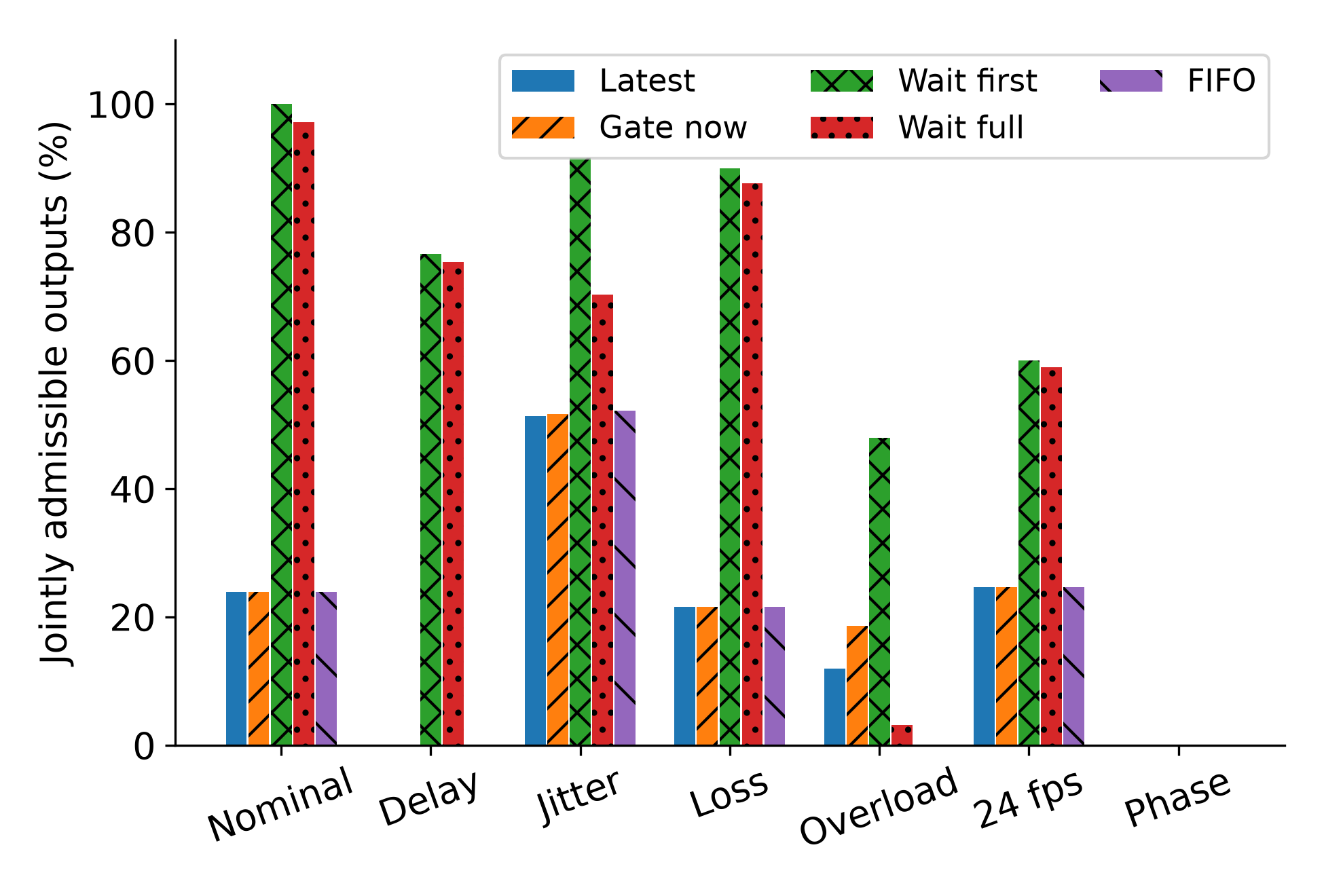
Fig. 1 Jointly admissible output proportions under synthetic workloads. Means over 40 seeds; admissibility requires skew ≤ 10 ms and primary age ≤ 60 ms. Zero in the phase case denotes no admissible output, not perfect synchronization.
6.2 Overload separates output from timeliness
Under the 45 ms mean service workload, latest emits 50.68% of primary frames and produces 11.88% jointly admissible outputs. Wait first produces 47.90% jointly admissible outputs, while wait full produces 3.12%. The paired difference between the two waiting policies is 44.78 percentage points, with a descriptive 95% interval of 44.63 to 44.93. The mean per run 95th percentile age is 59.79 ms for wait first and 77.65 ms for wait full. Spending the whole budget is damaging when service already occupies much of the age allowance.
FIFO latest emits 99.96% but only 0.06% of primary frames become jointly admissible outputs. Its mean per run 95th percentile age reaches 19,968.86 ms. This is not a measured device stall: it is the expected consequence of placing a roughly 45 ms server behind a 33.33 ms arrival process and retaining the backlog. A smooth count of completed outputs can conceal severe temporal failure.
Table 1 Overload results at ε = 10 ms and B = 20 ms. Age is the mean of per run 95th percentiles.
| Policy | Joint % | Age ms |
|---|---|---|
| Latest | 11.88 | 57.47 |
| Gate now | 18.62 | 58.95 |
| Wait first | 47.90 | 59.79 |
| Wait full | 3.12 | 77.65 |
| FIFO | 0.06 | 19968.86 |
6.3 Loss and unavailable matches
Under 10% independent secondary loss, wait first yields 89.89% jointly admissible outputs. During the one second secondary outage, its proportion is 98.33%. These values reflect refusal to synthesize or relabel missing data. Latest continues to produce many frames by reusing older secondary images, but output continuity does not establish synchrony. An application could choose a visibly marked fallback rather than reject, but that would change the objective and must be evaluated separately.
The 24 frame per second secondary scenario gives 60.00% jointly admissible outputs with wait first. The equal rate phase offset scenario gives zero for both waiting policies at ε = 10 ms: the nearest possible gap is 16 ms. That result is a structural negative control and does not depend on enlarging the wait budget. A policy designed to enforce a specification should expose an infeasible specification rather than silently count stale pairs as successes.
6.4 Sensitivity to the waiting budget
Figure 2 shows that waiting budget is not a monotone performance control. More time can admit delayed corresponding frames, but it can also lengthen occupancy and increase rejection of future primary callbacks. Full budget waiting pays this cost on every accepted primary, even when a suitable secondary frame is already present. First admissible matching avoids that particular cost, but remains subject to service load, lost samples and infeasible capture phase.
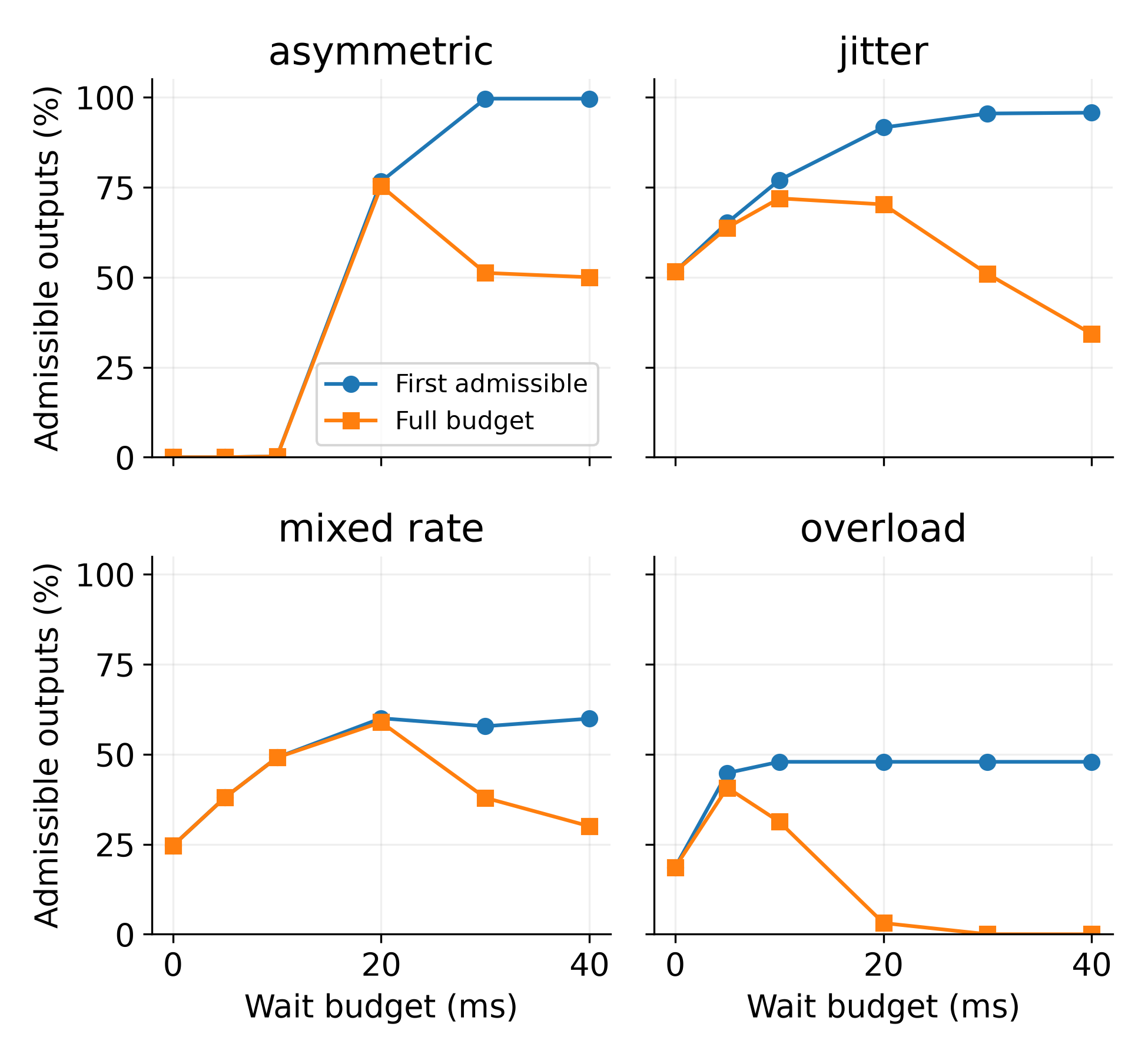
Fig. 2 Joint output proportion versus wait budget. Each point averages 40 synthetic traces. Both policies use ε = 10 ms and K = 8. Full budget waiting is not consistently improved by a larger budget.
Capacity and tolerance results are supplied in Online Resource 1. A larger cache cannot create temporally compatible samples absent from the capture sequence. Relaxing tolerance can increase the accepted proportion by definition, so it is not evidence of improved temporal fidelity. Choosing ε from the same benchmark to maximize acceptance would conflate a changed requirement with a better algorithm. A deployment must specify acceptable skew before comparing policies.
7 Retrospective device observations
The application development records dated 22 September 2026 document two configurations on an iPhone 16 Pro. Both were used to check whether the selfie preview continued while switching to another app during screen recording. The records summarize capture and saving diagnostics. The iOS version and total number of attempts were unavailable. The two configurations were selected for troubleshooting and were not controlled repetitions.
Build 1.1 (6) showed a black preview after switching apps. The record reports two background camera frames across approximately 0.033 s, with multitasking camera access reported as unsupported and disabled. The same record attributes the interruption to camera unavailability with multiple foreground apps.
Debug build 1.1 (8), run with a temporary VoIP configuration, reported 436 background camera frames and 436 preview frames over 14.500 s. The camera recording contained 530 frames over 17.634 s, with zero encoder drops reported. Separate Photos save-success markers were recorded for the camera and screen files. The diagnostic configuration and brief interval limit the observation to that run.
These checks concern whether a source remains available upstream of pairing. Equal camera and preview counts do not reveal frame correspondence, timestamp skew or output age. Neither run compared the scheduler policies or recorded the paired front and rear camera timing needed to estimate those quantities. The historical records therefore inform interpretation of source failure, and the controlled comparison in Section 6 provides the evidence for scheduler tradeoffs.
8 Implications for implementation
The first implementation requirement is to retain secondary presentation timestamps alongside pixel buffers. A latest buffer reference alone cannot support the tolerance check. A second requirement is to distinguish pending matching, active composition and output completion in diagnostics. A missed frame should have an explicit cause such as busy, timeout, absent secondary, source discontinuity or encoder backpressure; otherwise observed losses cannot be attributed to the matching policy.
The single slot model is intentionally conservative. A production system could decouple pairing from rendering, use a bounded primary queue, cancel pending requests when fresher ones arrive, or adapt capture rate. Each choice changes the service discipline and requires another comparison. The current results do not establish that holding a slot during matching is optimal. They show why pairing and admission must be evaluated together under the same workload.
Integration should preserve the native synchronizer as a baseline where the capture configuration supports it. The platform’s dropped data metadata, callback queue behavior and compatibility must be measured on the actual device and operating system. No modification of the application or deployment to users was performed in this study. A direct implementation benchmark should log both streams’ timestamps and callback arrivals, matching decisions, render start and end, and downstream append outcomes without recording identifiable imagery.
The model deliberately permits secondary reuse. For recording a reaction inset, reuse may preserve continuity but introduces temporal repetition. For stereo reconstruction or scientific measurement, one to one correspondence may instead be required. The numerical results cannot be transferred to that setting without changing the matcher, metrics and baseline consumption semantics. Similarly, a 60 ms primary age threshold is not a substitute for display latency or audio visual synchronization testing.
9 Limitations and validity
The controlled comparison uses synthetic timing traces and models composition as a service interval. The retrospective device summaries cover capture continuity in a different workflow and do not validate the timing model. Gaussian arrival and service models do not represent thermal throttling, correlated driver bursts, graphics queue stalls, rolling shutter or memory pressure. The reported intervals are conditional on eight constructed families. A broad real world performance claim would require multiple devices, capture modes, sustained recordings and an independently specified trace protocol.
Timestamp alignment is assumed, not estimated. The phase negative control demonstrates one consequence of violating exposure alignment, but clock drift, timestamp bias and discontinuities need dedicated tests. The single clock assumption is plausible as an interface contract within some pipelines, yet it must be verified rather than inferred from a shared phone chassis.
The work does not benchmark optimized implementations of ROS or Apple synchronization, and does not establish state of the art superiority. The proposed comparison uses straightforward mechanisms; its originality rests on the explicit joint model, reproducible contrasts and negative controls. A more comprehensive literature comparison and an independent implementation audit would strengthen a submission. No claim is made about reduced battery use, image quality, user preference or commercial reliability.
The final draft must be checked by the named author. AI assisted generation can introduce subtle model assumptions or omissions even when code executes correctly. Tests of budget and tolerance invariants do not prove that the chosen model answers the most important deployment question. Retaining executable source, parameter files and unsuccessful scenarios makes such scrutiny possible but does not replace it.
10 Conclusion
In the specified synthetic compositor, immediate latest frame selection favors output count without guaranteeing a coherent pair. Waiting until the first admissible secondary frame can recover many matching opportunities, while waiting for the whole budget can substantially reduce timely output under overload. A bounded wait provides a local scheduling bound but no unconditional end to end age guarantee. When capture phase makes a tolerance infeasible, buffering cannot repair it. These results support evaluating timestamp compatibility, admission control and output age together. The device observations add a distinct deployment consideration: the operating system can interrupt source delivery before any matching decision is possible.
Statements and declarations
Funding: No external funding was received for this work. Competing interests: The author develops the Tongkuang dual camera application and has a potential commercial interest in related recording technology. The simulation does not establish the performance of that product. Human participants: None. Author contributions: Zishuo Yang supplied the motivating application and is the sole intended author; final responsibility for review and approval remains with the author. AI assistance is described in Section 5.
Data availability: Online Resource 1 contains the simulator, configuration, per run metrics and analysis scripts needed to regenerate the synthetic data. Section 7 reports aggregate values transcribed from the application’s internal release and troubleshooting records. No camera imagery or participant data are included. Code availability: The reference source is supplied with the supplementary package. No public repository or archival identifier has yet been assigned.
Online Resource 1: Reproducible synthetic callback experiment with six policies, eight workload families, sensitivity sweeps, configuration and result tables. The package includes instructions and code hashes. The numeric results are simulated and are not measurements of a deployed camera application.
References
1. Ansari S, Wadhwa N, Garg R, Chen J (2019) Wireless Software Synchronization of Multiple Distributed Cameras. IEEE International Conference on Computational Photography. https://doi.org/10.1109/ICCPHOT.2019.8747340
2. Albl C, Kukelova Z, Fitzgibbon A, Heller J, Smid M, Pajdla T (2017) On the Two View Geometry of Unsynchronized Cameras. arXiv:1704.06843. https://doi.org/10.48550/arXiv.1704.06843
3. Apple (2026) AVCaptureDataOutputSynchronizer. Apple Developer Documentation. https://developer.apple.com/documentation/avfoundation/avcapturedataoutputsynchronizer. Accessed 16 November 2026
4. Apple (2026) init(dataOutputs:). Apple Developer Documentation. https://developer.apple.com/documentation/avfoundation/avcapturedataoutputsynchronizer/init(dataoutputs:). Accessed 16 November 2026
5. ROS 2 contributors (2026) message_filters documentation and source. https://github.com/ros2/message_filters. Accessed 16 November 2026
6. Apple (2017) Handling Frame Drops with AVCaptureVideoDataOutput. Technical Note TN2445. https://developer.apple.com/library/archive/technotes/tn2445/_index.html. Accessed 16 November 2026
7. Yates RD, Sun Y, Brown DR III, Kaul SK, Modiano E, Ulukus S (2021) Age of Information An Introduction and Survey. IEEE Journal on Selected Areas in Communications. https://doi.org/10.1109/JSAC.2021.3065072